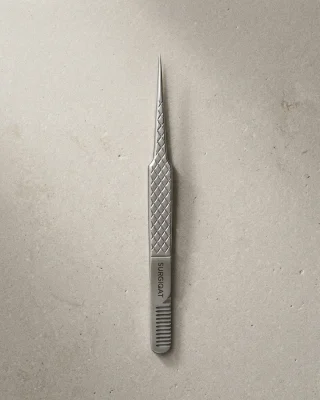
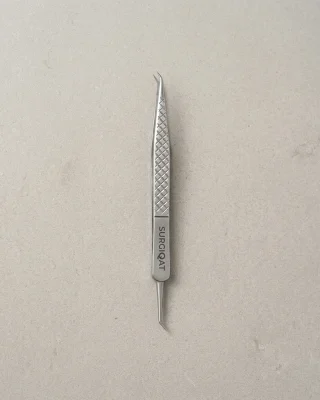
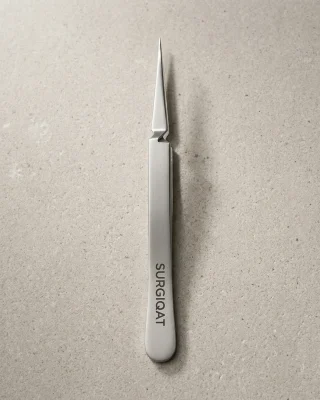
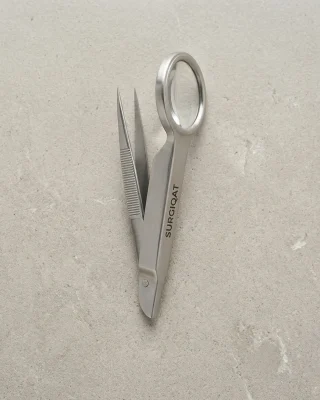
Why Standard Brow Tools Fail at Trapped Hair Extraction
Everyday buyers and new waxing technicians often assume any sharp-looking tweezer can handle trapped hair extraction, only to discover why specialty skincare tools exist. Standard slanted brow tweezers are engineered to press flat against the brow bone across a wide contact zone. Against a tiny loop of trapped hair sitting inside a tender pore, wide edges block the user's sightline completely.
Reviews from estheticians, waxing studios, and skincare shoppers point to four common failures in poorly made extraction tweezers:
Blunt or Rounded Needle Tips: Mass-stamped blanks that skip careful taper grinding leave thick, stubby points that push delicate skin aside without ever catching the trapped hair loop.
Crossed or Scissoring Points: When thin metal shanks lack controlled spine rigidity, squeezing firmly causes one point to slide past the other—dropping the hair mid-pull and pinching skin instead.
Harsh Glare Under Salon Magnifying Lamps: Mirror-bright handles reflect overhead inspection lights straight into the esthetician's eyes, hiding fine light-colored shafts right at the skin line.
Rusting or Peeling After Disinfection: Because extraction tools work close to irritated follicles, they require strict EPA-registered liquid disinfection between every client. Weak alloys corrode at the spine and cheap coatings peel quickly.
Sourcing purpose-built ingrown hair tweezers crafted from surgical grade steel with manual magnification checks eliminates these frustrations and turns a high-anxiety grooming task into clean, controlled care.
Clinical Context: Why Clean Extraction Matters for Follicle Health
Dermatology case literature underscores how directly clean mechanical extraction affects skin recovery. A clinical report in the National Library of Medicine (PMC11700942) describes dermatoscopic extraction of trapped ingrown hairs using a sterile fine instrument and precision tweezers, while another dermatology study indexed at PMC7380697 notes that post-hair-removal folliculitis lesions resolve once retained hair shafts are extracted cleanly with tweezers. While licensed estheticians and consumers work strictly within cosmetic, non-medical care boundaries, clean tip geometry and proper disinfection are essential for minimizing skin irritation.