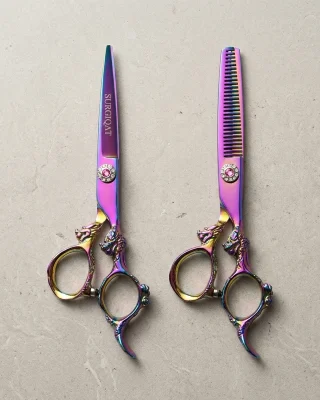
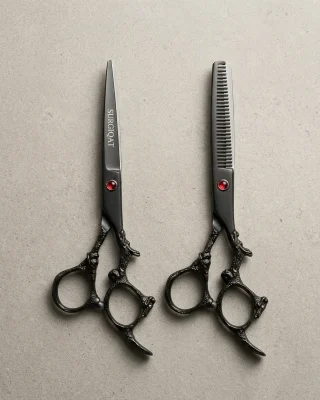
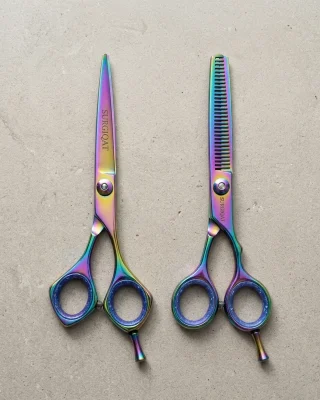
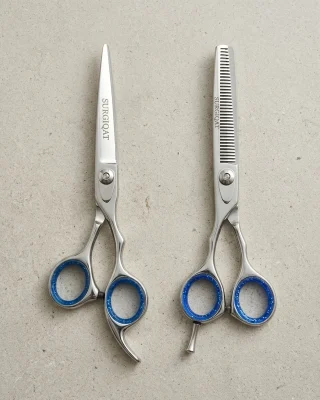
Before placing a volume order for barber scissor sets, walk through these nine factory-level checks with your supplier. Each one directly prevents the most common wholesale returns and retail 1-star reviews.
1. Confirm Both Shears Share the Exact Same Handle Geometry
Barbers switch between their cutting shear and thinning shear dozens of times per haircut. If the cutting shear has a relaxed offset thumb ring and the thinning shear uses a steeper classic shank, the barber's wrist resets its angle every time they swap tools.
In a properly matched set, both shears share the same handle architecture—whether you spec classic/straight, offset, crane, or swivel handles. Ring diameters, finger-rest placement, and shank curvature should mirror each other so muscle memory carries cleanly across the pair.
2. Verify a Matched Japanese Steel Scissor Pair Across Every Piece
Some low-cost bundles put better steel in the main cutting shear and drop down to a softer alloy in the thinner, assuming buyers will not notice. Barbers notice within a month because the thinner loses its clean bite first and starts folding hair between the teeth.
Specifying a matched Japanese steel scissor pair keeps edge retention consistent across the whole box. At Surgiqat, buyers choose from three standard Japanese steel grades depending on target price tier:
|
Japanese Steel Grade
|
Best Catalog Positioning
|
Typical Set Application
|
|
J1 (Basic)
|
Entry-level & student sets
|
Training academies, budget starter pairs, promotional retail sets
|
|
J2 (Normal)
|
Mid-tier salon & barbershop sets
|
Everyday working barbershops, high-turn distributor SKUs
|
|
440C (Professional)
|
Flagship professional sets
|
Established private-label lines, senior stylists, precision fade sets
|
For custom OEM briefs aimed at boutique flagship collections, we also work with VG10 and ATS-314 Japanese steel. We keep those strictly for custom briefs rather than a usual first order, since most distributors validate their set configuration and packaging with J1, J2, or 440C first.
If your internal QA team or retail partner asks for metallurgy paperwork, we provide three standard steel test reports on request: a Material test report (MTR) / Material test certificate (MTC), a Chemical composition analysis, and a Hardness test report.
3. Match the Blade Grind to the Cutting Job—Not Just Visual Style
Inside a 2-piece or 3-piece set, blade grinds must complement each other. Pairing a razor-sharp convex cutting shear with a clunky, over-ground thinning blade ruins the flow of a dry blend.
Here is how we typically pair edge grinds inside barber scissor sets:
Convex + Convex Thinning/Blending: Smooth, quiet slicing for dry texturizing, slide cutting, and clean fade blending.
Semi-Convex + Semi-Convex Thinning: Balanced durability and smooth cutting for high-volume barbershops handling coarse hair all day.
Beveled or Micro-Serrated + Standard Thinning: Controlled grip that holds straight or coarse hair without pushing, popular in school and entry-level sets.
4. Lock the Tension System Across the Full Set
A subtle mismatch that irritates working barbers is mixing screw styles inside one box—such as a sleek click-dial adjuster on the cutting shear and a plain slotted flat screw on the thinner. Even if both blades cut well, the set looks cobbled together from leftover stock.
Decide upfront whether your set uses a flat screw, a dial/click adjuster, or a ball-bearing pivot, and apply that exact hardware across every shear in the pouch. Consistent hardware also simplifies tension tuning for the end user, because one tension key or click-dial adjustment handles the entire set.
5. Require Batch-Matched Finishes Across 100+ Color Options
Color sets sell fast on retail shelves and e-commerce listings, yet color-tone drift is one of the easiest ways to trigger returns. Two matte-black shears or two colored shears finished in different runs can show slight sheen or shade differences when placed half an inch apart in a gift box.
At Surgiqat, we offer matte, mirror polish, and 100+ color options. For multi-piece sets, we pair components from matched finish runs and check side-by-side color consistency under bright inspection lighting before packing. If you want a two-tone accent—like matte blades with a bright pivot screw—we lock that finish combination onto your buyer spec sheet so reorders match your first batch.
6. Audit True Left-Handed Pairings Separately
Left-handed barbers are among the most loyal repeat customers a brand can earn, largely because they are tired of receiving poorly assembled sets. A frequent complaint in online reviews is opening a "left-handed" cutting and thinning scissor set only to find a reversed cutting shear paired with a standard right-handed thinner.
True left-handed sets require both shears to be manufactured with reversed blade orientation—top blade on the left—so the barber can see their cutting line clearly and close the blades with natural thumb pressure. Never let a factory simply flip a right-handed handle upside down to fill a left-handed set order.
7. Test the Thinning Shear First in Every Cutting and Thinning Scissor Set
When evaluating a sample set, most buyers open the cutting shear first, make three snips on dry tissue or a hair swatch, and assume the thinner is fine. Do the opposite. Inspect the thinning shear first.
Close the thinning shear slowly and listen for any scraping or catching where the straight blade crosses the toothed blade. Make five slow cuts through a clean hair swatch and pull the shear straight out without twisting. If any tooth snags or tugs hair during release, reject the grind before approving bulk production.
8. Inspect Custom Barber Scissor Case Packaging for Real Station Hygiene
A pouch or box is not just unboxing theater—it protects precision edges during transit and supports daily barbershop sanitation. Under the Texas Department of Licensing and Regulation (TDLR) Inspections Guide for Barbering and Cosmetology, haircutting shears and multi-use implements must be wiped clean and disinfected after each client, scrubbed with soap and water and immersed at the end of the day, and stored in a clean, dry, debris-free environment separate from soiled implements.
That real-world compliance rule explains why flimsy, fuzzy-lined cases frustrate working barbers. Hair clippings trap inside cheap velvet, and moisture from disinfected shears causes low-grade synthetic linings to peel and smell. When planning custom barber scissor case packaging, choose wipe-clean interiors, separated blade slots or firm elastic loops so edges never collide, and sturdy zippers or magnetic closures that hold up to daily station use.
At Surgiqat, we supply individual pouches, protective multi-shear cases, and branded retail boxes tailored to your exact set count.
9. Lock Laser Logo Placement With a Digital Proof Before Engraving
In a multi-piece set, logo proportion matters. A logo sized cleanly for a 7.0-inch cutting shear can look cramped on a 6.0-inch thinning shear if the factory does not scale and center the mark for each blade shank.
We handle branding through laser logo engraving and send a digital logo placement proof before production begins. You review exact logo sizing, orientation, and spacing on every shear in the set—plus case branding—so the finished pair looks unified straight out of the box.