Whether you are supplying a 100-student barber college, stocking a regional salon supply store, or launching an online private-label brand, these ten practical specifications keep your multi-tool bundles out of the return pile.
1. Anchor the Kit Around Verified Japanese Steel Shears
In almost every budget kit complaint, the shears are the first thing buyers throw away. One buyer notes their first pair cut fine while a second kit from the same cheap line arrived dull straight out of the box.
Start every kit spec by locking the Japanese steel grade for the included Barber Cutting Scissors and Barber Thinning Scissors. At Surgiqat, buyers structure kit tiers across three standard Japanese steel grades:
|
Kit Tier
|
Japanese Steel Grade
|
Best B2B Channel
|
Core Hand-Tool Focus
|
|
Academy / Starter
|
J1 (Basic)
|
Barber schools, student kits, entry retail
|
Durable beveled/semi-convex shears + starter razor + wipe-clean pouch
|
|
Everyday Shop
|
J2 (Normal)
|
Wholesale distributors, local supply stores
|
Balanced offset shears + everyday barber razor + structured zip case
|
|
Flagship Brand
|
440C (Professional)
|
Established private-label brands, senior barbers
|
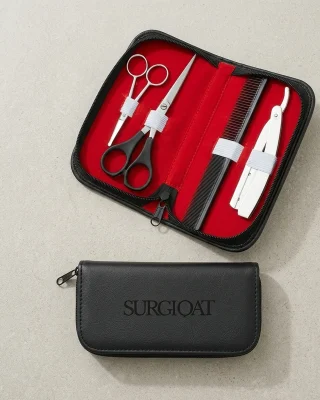
Convex cutting & thinning pair + matching razor + custom branded box/roll
|
For specialized custom briefs targeting boutique high-end releases, we also manufacture shears in VG10 and ATS-314 Japanese steel. We reserve those strictly for custom briefs rather than a usual first order so new kit programs can prove sell-through on J1, J2, or 440C first.
When academy directors or retail QA teams request metallurgy documentation, we provide three standard reports: a Material test report (MTR) / Material test certificate (MTC), a Chemical composition analysis, and a Hardness test report.
2. Build a Cohesive Custom Shear and Razor Kit
A custom shear and razor kit feels dramatically more professional when the shears and the Barber Razors share a unified visual and ergonomic identity. Too many wholesale kits pair a sleek matte-black shear with a bright chrome razor pulled from an unrelated bin.
Coordinating finish tones—across matte, mirror polish, or our 100+ color options—makes the entire kit photograph cleanly for e-commerce listings and look intentional on a retail shelf. Even more importantly, keeping finish runs matched across the kit prevents color-shade drift between tools sitting side by side in the same case.
3. Select the Right Handle Style for Apprentice Barber Hand Tools
New barbers and students spend hours practicing shear-over-comb fundamentals and sectioning on mannequins before moving to live chairs. Choosing awkward handles for apprentice barber hand tools builds bad wrist habits early and leads to hand fatigue.
We manufacture kit shears across four handle styles—classic/straight, offset, crane, and swivel—so you can match the exact teaching curriculum or shop preference:
Offset Handles: The most forgiving all-around choice for student kits and general shop bundles, letting the thumb sit lower without forcing the elbow up.
Classic/Straight Handles: Preferred by traditional barber academies that teach classic symmetrical finger grip and flipping techniques.
Crane & Swivel Handles: Ideal for ergonomic upgrade kits targeted at experienced barbers logging long shifts.
4. Match Edge Grinds to Real Skill Levels
Blade grind selection directly affects how long your kit shears stay sharp in real use. Pairing ultra-delicate edges with first-week students who accidentally clip combs leads to chipped blades and frustrated school directors.
Beveled or Micro-Serrated Edges: Excellent for academy starter bundles because the subtle grip prevents hair from slipping while students master clean straight lines.
Semi-Convex Edges: A dependable middle ground for everyday shop bundles, offering smooth slicing with solid edge durability.
Convex Edges: Best reserved for flagship professional barber starter bundle SKUs and senior-barber kits built for dry slide cutting and soft blending.
5. Standardize Tension Hardware Across Every Shear in the Kit
Small hardware details expose lazy sourcing immediately. If the cutting shear carries a click-dial adjuster and the thinning shear uses a basic slotted screw, buyers assume the kit was assembled from leftover parts.
Lock one tension system—flat screw, dial/click adjuster, or ball-bearing pivot—across all shears in the kit. Dial/click adjusters are especially popular in student and retail bundles because users can fine-tune blade tension in seconds without misplacing a separate tension key.
6. Include Dedicated Left-Handed Kit Variants From Day One
Roughly one in ten barber students is left-handed, yet many school suppliers forget to include true left-handed SKUs when ordering seasonal student bundles. Handing a left-handed apprentice a right-handed shear forces them to push the blades apart instead of together, causing hair to fold between the edges.
At Surgiqat, we manufacture both right-handed and true left-handed shears (with properly reversed blade orientation, not flipped handles). Ordering a dedicated left-handed allocation alongside your primary right-handed run lets academies equip every student on day one without scrambling for last-minute replacements.
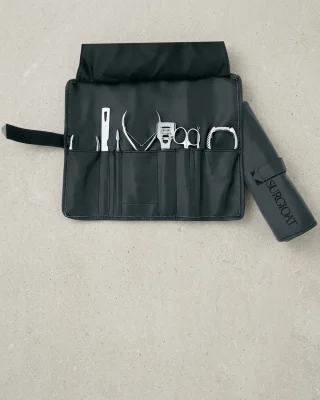
7. Design a Private Label Barber Roll Case or Structured Box That Cleans Easily
Because state boards such as the Alaska Board of Barbers and Hairdressers require disinfected implements to be stored in a clean, dry, covered container away from contaminants, your kit case needs to work as hard as the tools inside it.
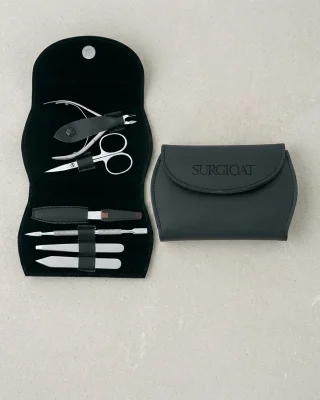
When planning a private label barber roll case, zip travel case, or branded retail box, focus on four practical details:
Individual Tool Separation: Dedicated stitched slots or firm elastic loops keep shear edges and razor frames from knocking against each other in transit.
Wipe-Clean Interiors: Smooth, non-shedding linings let barbers wipe out stray hair clippings quickly rather than trapping debris inside cheap fuzzy fabric.
Full Closure: Zippers, snaps, or magnetic box lids keep tools covered between clients and protected inside rolling station carts.
Compact Footprint: A trim case fits neatly on crowded barber stations without eating up clipper space.
8. Keep Accessory Counts Focused on Daily Utility
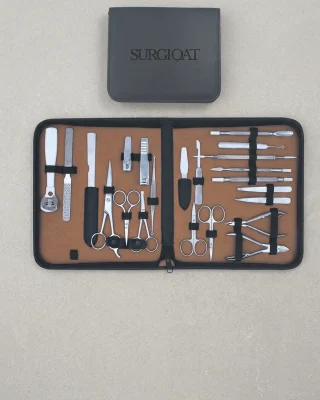
More pieces do not equal a better kit. Every extra low-grade comb or brittle clip added just to advertise "18 pieces" drags down the perceived quality of your Japanese steel shears.
Build your custom bundles around a tight, practical bill of materials that barbers actually reach for:
Essential 4-Piece Core: Cutting shear + thinning shear + barber razor + protective branded pouch/case.
Academy 6-Piece Bundle: Cutting shear + thinning shear + barber razor + tension/care cloth + sectioning clips/comb + structured roll or zip case.
Pro Station Upgrade Kit: 7.0" scissor-over-comb cutting shear + 5.5" detail cutting shear + blending shear + matching barber razor + custom presentation case.
9. Approve a Digital Logo Placement Proof Across Every Kit Piece
Private-label station bundles command stronger margins when branding looks sharp and consistent across every item in the tray. Unscaled logos—too big on a razor shank, too faint on a matte shear—make a custom kit look rushed.
We apply brand marks via laser logo engraving and send a digital logo placement proof before bulk production starts. You inspect exact placement, proportion, and orientation across each shear, razor, and custom case before we cut steel or engrave a single batch. All client logos and exclusive custom designs stay strictly confidential and are never resold.
10. Lock Every Repeat Order to an Approved Golden Sample
Schools enroll new cohorts every quarter, and distributors reorder top-selling grooming bundles year-round. The biggest risk in kit manufacturing is drift—batch two arrives with a slightly stiffer hinge, a different finish tone, or looser case stitching than batch one.
At Surgiqat, once you sign off on your sample kit, we retain an approved golden sample at the factory and archive your full buyer spec sheet. Every reorder is built and checked against that locked reference so batch five matches batch one.