


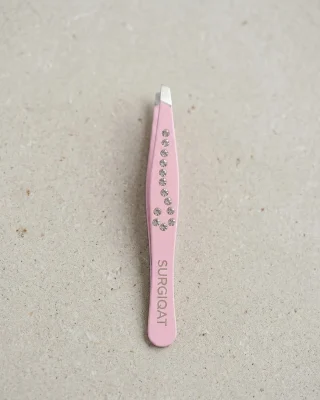
Why Salon Buyers Return Poorly Made Angled Brow Tweezers
Most wholesale complaints about angled brow tweezers trace back to shortcuts taken during tip grinding and heat finishing. In high-speed mass stamping, factories often leave microscopic light gaps at the very front point or leave the inner mating faces slightly convex. When an esthetician or retail shopper closes the arms lightly against a fine brow or chin hair, the rear heel of the bevel touches first while the leading corner stays open by a fraction of a millimeter.
That tiny gap ruins performance in two ways. First, thick or rounded leading edges push flat against the skin and skid right over short, coarse regrowth. Second, when the user squeezes harder to force the front corner shut, the bevel acts like a blunt scissor blade and slices the hair cleanly at skin level. Instead of clean root removal, the client ends up with stubbly regrowth two days later and blames the tool brand.
Another common pain point in professional studios is inconsistent arm resistance. When the rear weld or folded spring spine is too stiff, a brow artist performing eight to ten shaping appointments per day develops thumb and forefinger fatigue by mid-afternoon. Conversely, arms that are too soft lose their return spring after a few weeks of daily salon use, causing the tips to drift out of lateral alignment.
Finally, low-grade surface coatings frequently bubble, chip, or peel after repeated soaking in salon disinfectant baths. Because licensed estheticians must clean and disinfect non-porous metal tools between every client, a cosmetic finish that flakes off inside a soaking tray quickly turns an attractive retail SKU into a hygiene liability.
What Estheticians and Retail Shoppers Expect from Everyday Brow Tools
Professional brow technicians and repeat retail buyers judge a diagonal tweezer within the first three seconds of testing it on a single fine hair. They look for effortless closure under light fingertip pressure, a crisp flat edge that hugs the brow bone without scratching the skin, and zero light passing through the closed gripping zone when held toward a lamp.
Meeting those expectations across hundreds or thousands of repeat units requires controlled steel forming, careful bevel finishing, and manual verification before packing. At Surgiqat, we treat every 20-piece starter order with the same tip-alignment discipline applied to multi-thousand-unit distributor shipments.