Real user complaints on shaving forums repeat the same frustrations: blades sliding out when shaken, uneven corner exposure that nicks cheek skin, and lather packing tightly inside poorly machined arms. Audit these eight specs on your one-week sample before ordering bulk.
1. Compare Clip-Lock and Slide-In Shavettes for Your Target Buyer
Not every barber prefers the same loading mechanism. Offering both clip-lock and slide-in shavettes lets your wholesale catalog match regional shop habits cleanly:
|
Shavette Mechanism
|
How It Loads
|
Best B2B Buyer Channel
|
|
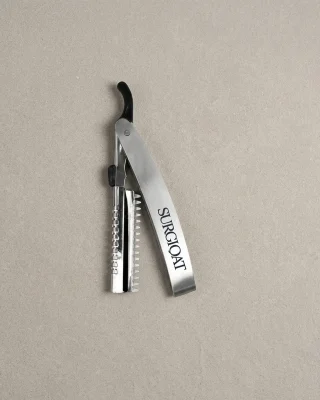
Swing / Flip-Lock Clip
|
Two-piece hinged blade arm swings open, seats half blade on pins, and locks with a rear clip
|
High-volume fade barbershops needing ultra-fast blade swaps and easy open rinsing
|
|
Slide-In Sleeve Holder
|
Inner tray slides out of the outer arm, holds the blade securely, and slides back in
|
Barber schools, traditional shavers, and buyers who prefer enclosed blade edges
|
|
Push / Spring-Lock Holder
|
Spring-tensioned jaws open cleanly for quick drop-in loading
|
Mobile barbers and modern private-label grooming lines
|
Whatever mechanism you choose, the locking action must click home firmly without requiring excessive fingernail force that risks nicking the barber during blade changes.
2. Verify Pin Alignment and Zero Wobble on Every Half DE Blade Razor Holder
The single biggest safety failure on a cheap half DE blade razor holder is sloppy locating pins. If the pins sit slightly off-center or too short, a half double-edge blade shifts sideways as soon as the arm closes—leaving one corner jutting out dangerously while the other corner hides inside the spine.
Inspect three details on every sample:
Flush Seating on Pins: Lay a standard half blade onto the internal locating pins; it should drop into place cleanly with zero tilt.
Even Edge Reveal: Close the holder and inspect the cutting edge under bright light from heel to toe. Exposure must stay completely parallel and uniform.
Zero Shake Play: Tap the closed spine gently against your palm. If the blade shifts or rattles even a fraction of a millimeter, reject the tolerance before approving production.
3. Build Every Blade Arm From Corrosion-Resistant Surgical Grade Steel
Shavette arms spend hours wet with warm lather, alcohol sprays, and hospital-grade disinfectant immersion solutions. Thin plated zinc arms pit, corrode around the hinge pin, and lose clamping tension within months.
At Surgiqat, we manufacture our shavette razors from surgical grade steel so the blade arm stays rigid, non-porous, and corrosion-resistant across daily barbershop sanitation cycles. Whenever retail partners or institutional QA teams request material verification, we supply three standard steel test reports on request: a Material test report (MTR) / Material test certificate (MTC), a Chemical composition analysis, and a Hardness test report.
4. Engineer Easy-Rinse Channels That Prevent Hair and Lather Clogging
One frequent complaint from daily shavette users is cut stubble wedging tightly between the blade and the holder arm, forcing them to stop mid-shave, unclip the razor, rinse it out, and reload. Cleanly beveled holder cheeks and crisp edge tolerances keep lather flowing smoothly off the spine so barbers can rinse quickly under warm water and finish a lineup without interruption.
5. Design Your Barbershop Lineup Shavette Around Balanced Visibility
Modern barbers rely on a barbershop lineup shavette to carve razor-sharp forehead lines, crisp temple C-cups, and sharp cheek contours. An overly thick, chunky blade arm blocks the barber's view of the hairline and forces awkward wrist angles.
Slim, tapered surgical grade steel arms give clear sightlines right down to the blade corner—letting barbers trace tight curves around ears and mustaches with light, controlled strokes.
6. Match Handle Materials to Immersion Cycles and Brand Positioning
Handle scales shape both hand balance and sanitation workflow:
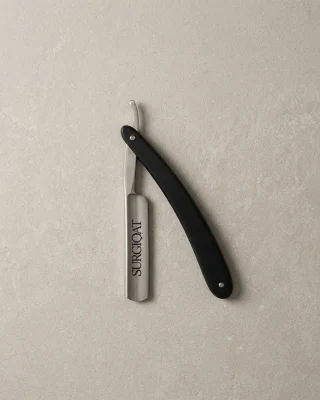
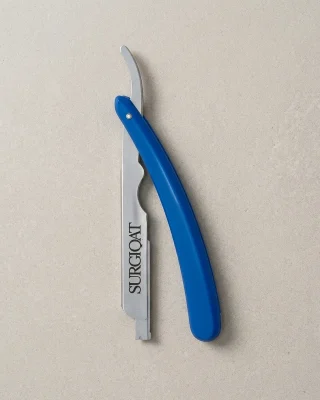
Razor Plastic Handle: Featherweight, non-porous, and ideal for rapid beard detailing, barber colleges, and repeated liquid disinfection.
Razor Steel Handle: Balanced solid weight and maximum immersion durability for commercial barbershop stations.
Razor Wooden Handle: Classic warm grip favored by boutique barbershops and private-label retail gift boxes.
Check pivot tension closely on every handle type: the blade arm should open smoothly with one hand, hold steady at working angles, and fold dead-center between the scales without scraping.
7. Support Safe Used-Blade Disposal Workflows
Used disposable blades are regulated commercial sharps. Public health agencies—such as Skagit County Public Health Sharps Disposal guidelines—require businesses to collect and dispose of used sharps safely through proper containers and licensed handling rather than regular trash.
Smooth-opening clips and slide trays let barbers release a spent half blade directly into a puncture-resistant sharps container with minimal finger contact—a practical detail barbershop owners appreciate immediately.
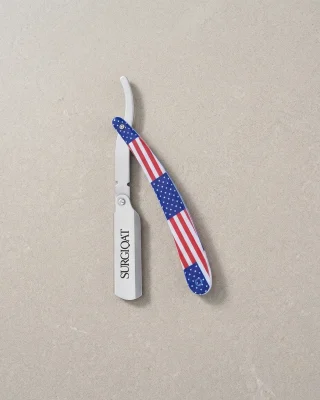
8. Offer Standout Finishes Across Matte, Mirror Polish, and 100+ Color Options
Barbers love coordinating their station tools—matching their shavette finish to their cutting shears and clippers. At Surgiqat, buyers choose from matte, mirror polish, and 100+ color options, letting distributors build cohesive color collections alongside Barber Razors and Barber Razor Sets.