Before placing a bulk order for salon shaving razors, audit these seven mechanical and hygiene details on your sample. Each check directly addresses the real shop failures that ruin wholesale margins.
1. Test Zero-Wobble Clamping on Every Replaceable Blade Barber Razor
Blade security is non-negotiable. When a barber loads a fresh half double-edge blade or salon blade into a replaceable blade barber razor, the blade must seat flat against internal alignment pins or locking channels with zero lateral play.
Run a quick bench test on every sample:
Pin & Channel Fit: Open the holder and inspect the locating pins or slide rails. Bent pins or shallow grooves let blades shift off-angle as soon as the locking clip closes.
Even Blade Exposure: Once latched, inspect the exposed cutting edge from heel to tip under bright light. Uneven exposure—more blade sticking out at the toe than the heel—causes accidental nicks during crisp beard lineups.
Zero Shake Movement: Gently tap the spine against your palm with a blade locked inside. If the blade rattles, shifts, or slides, reject the tolerance before approving production.
2. Verify Surgical Grade Steel Razor Holder Construction and Corrosion Resistance
Barbershop razors live in a harsh chemical environment: hot water, alkaline shaving lather, alcohol sprays, and hospital-grade immersion disinfectants all day long. Under the Ohio State Cosmetology and Barber Board Infection Control Standards, used non-porous implements must first be cleaned with warm soapy water to remove debris and then completely immersed in an appropriate disinfectant solution for the full recommended contact time before being stored in a closed, dust-proof container.
Using a surgical grade steel razor holder prevents rust pitting inside the blade slot, protects hinge pins from seizing up, and keeps surfaces smooth and non-porous so barbers can sanitize quickly between clients. Whenever wholesale buyers or institutional QA teams ask for material documentation, Surgiqat provides three standard steel test reports on request: a Material test report (MTR) / Material test certificate (MTC), a Chemical composition analysis, and a Hardness test report.
3. Match Razor Architecture to How Your Buyer Channels Actually Shave
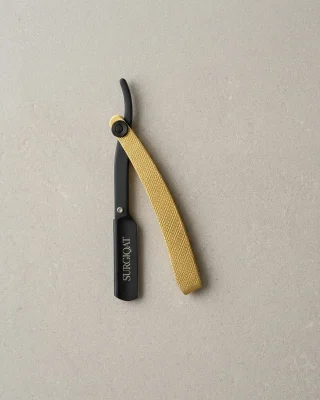
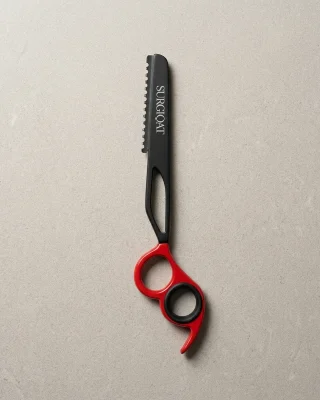
Not every barber or retail shopper wants the same razor format. Structuring your barber razors catalog around four distinct architectures keeps product listings clear and raises cross-sell rates:
|
Razor Format
|
Core Advantage
|
Best Wholesale Buyer Channel
|
|
Shavette Razors
|
Uses fresh disposable blades per client—zero honing required
|
Commercial barbershops, barber schools, state-board exam kits
|
|
Straight Razors
|
Solid forged folding blade for traditional wet-shave balance
|
Heritage barbershops, wet-shaving specialty stores, collector brands
|
|
Safety Razors
|
Guarded double-edge head with predictable skin protection
|
Men's grooming retail brands, gift sets, everyday home shavers
|
|
Barber Razor Sets
|
Coordinated multi-razor or razor-plus-case bundles
|
E-commerce private-label brands, academy enrollment kits, gift retail
|
Keeping these four formats clearly separated helps distributors match exact local health-board rules and consumer skill levels without confusion.
4. Select the Right Handle Material for Wet-Hand Control
Lather, pre-shave oil, and steam make barber stations slippery. Handle material directly affects weight balance, grip security, and immersion durability across wholesale neck shave tools:
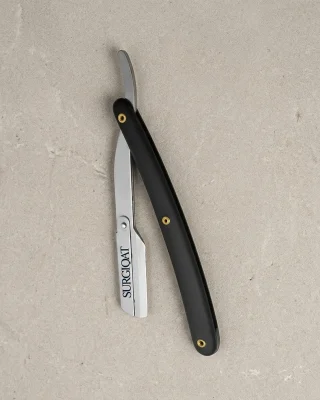
Razor Plastic Handle: Lightweight, agile, and fully non-porous—built for fast beard lineups, high-volume disinfectant soaking, and affordable barber school kits.
Razor Wooden Handle: Warm, heritage aesthetic with natural tactile grip favored by boutique barbershops and premium gift-box brands.
Razor Steel Handle: Substantial weight balance and maximum durability for heavy commercial immersion cycles and modern minimalist retail lines.
Inspect scale-to-tang fit closely on every handle type. Rough seams or loose rivets trap dried lather and shorten handle lifespan.
5. Check Pivot Tension and Safe One-Handed Folding
A barber opens and closes a folding razor dozens of times per day. If the pivot pin is too loose, the blade arm swings shut unexpectedly onto the barber's knuckles or drops open inside a station drawer. If the pivot is over-tightened, opening the razor smoothly with one hand becomes jerky and unsafe.
On every Surgiqat sample, verify smooth, steady pivot resistance from fully closed to the 270-degree open working angle, plus clean centering so the blade arm rests neatly between the scales without scraping either side when folded.
6. Design for Safe Blade Changes and Sharps-Container Workflows
Commercial barbershops follow strict bloodborne-pathogen and sharps-disposal standards. Under Iowa Administrative Code 645—63.11 (Universal Precautions), every salon must maintain a dedicated sharps container as close to the use area as practical for disposing of used razor blades and other sharp instruments, alongside disinfectant solution at each workstation.
Smart barber razors support safe blade swaps without forcing the barber to pry stuck blades out with bare fingernails. Slide-in sleeve mechanisms, flip-lock clips, and push-type holders should open smoothly so a used blade drops straight into a sharps box with minimal finger contact.
7. Lock Consistent Finishes Across Matte, Mirror Polish, and 100+ Color Options
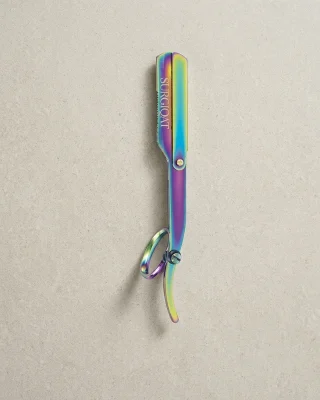
Visual identity sells razors fast—both on barbershop wall displays and on e-commerce product pages. At Surgiqat, buyers choose from matte, mirror polish, and 100+ color options across our surgical grade steel razor arms and handles.
For multi-piece orders and Barber Razor Sets, we match finish batches carefully so color tones stay uniform across every unit in the carton.