Sourcing OEM convex hair scissors requires tighter technical specifications than entry-level student shears. Put these six checkpoints in writing before you approve a bulk run.
1. Outer Arc Continuity and Inner Hollow Grind (The Ride Line)
A convex edge only performs as well as the invisible inside face behind it. The inside of each blade must be ground slightly concave (hollow-ground) so the two blades never slap flat against each other during closure.
Where the curved outer face meets that concave inner face, the factory hones a thin, bright contact strip called the ride line. As the blades close from pivot to tip, only that narrow ride line touches at a single moving point. If the hollow grind is uneven or the ride line widens inconsistently, the blades drag mid-stroke and dull weeks ahead of schedule.
2. Honest Technique Fit: Convex vs. Semi-Convex, Beveled, and Micro-Serrated
A razor-thin convex edge is not automatically the best choice for every haircut or every buyer tier. Being candid about edge trade-offs cuts distributor return rates immediately:
|
Edge Grind
|
Outer Geometry
|
Best Barbershop Techniques
|
Honest Limitation to Share With Buyers
|
|
Convex
|
Smooth continuous curve down to a fine edge
|
Slide cutting, slice cutting, point cutting, wet precision cuts, soft fades
|
Thinner edge chips faster if dropped on tile or abused on heavy dry blunt cuts
|
|
Semi-Convex
|
Gentle outer curve supported by a tiny micro-bevel
|
All-around daily barbershop cutting across both wet and dry coarse hair
|
Slightly less effortless on pure dry slide cutting than a full convex edge
|
|
Beveled
|
Distinct flat angled facet along the outer edge
|
Barber school kits, blunt cutting, heavy scissor-over-comb work
|
Pushes hair during slide cutting; requires more thumb pressure
|
|
Micro-Serrated
|
Tiny teeth milled onto one beveled blade edge
|
Beginners, crisp dry perimeter lines, slippery straight hair
|
Never use for slide cutting—the micro-teeth grab and pull strands
|
For private-label brands building a tiered catalog, position convex edge scissors as your flagship stylist and master-barber tier, semi-convex as your daily high-volume barbershop workhorse, and beveled or micro-serrated for academy starter kits.
Wet Cutting vs. Dry Cutting With Convex Blades
Many barbers ask distributors whether convex edge scissors can handle dry cutting as well as wet cutting. The honest factory answer is yes—provided the steel grade and cutting technique match the blade geometry.
On damp hair, strands soften slightly and lie smoothly in a comb, allowing a razor-thin convex edge to slice through cleanly with almost zero resistance. On dry hair, hair shafts are stiffer and more abrasive, especially around dense nape lines or thick coarse crowns. A sharp convex blade still excels at dry slide cutting, dry point cutting, and detailed finishing, because its smooth outer curve glides without catching.
Where buyers run into premature dulling is using a fine convex blade for heavy, high-volume dry blunt chops through thick sections all day. Advising barbers to keep a convex shear for slide, point, and wet precision work—and a semi-convex or beveled pair for heavy dry bulk cuts—extends sharpening intervals and keeps customers far happier with both models.
3. Japanese Steel Selection and Verifiable Hardness Testing
Because a convex edge tapers much thinner than a beveled edge, soft steel exposes itself almost immediately. Within a few busy weekends, a low-grade alloy rolls over along the fine edge, causing hair folding and split ends.
Steel performance depends on both alloy chemistry and consistent heat treatment. As detailed by the National Institute of Standards and Technology (NIST Special Publication 960-5), Rockwell C (HRC) hardness testing provides a standardized metallic hardness measurement used across industry to verify heat-treated steel consistency.
Surgiqat manufactures wholesale convex barber shears from Japanese steel across three clear standard tiers, plus two custom-only grades:
|
Japanese Steel Grade
|
Catalog Tier
|
Best Convex-Edge Role
|
Ordering Guidance
|
|
J1
|
Basic
|
Budget retail lines and entry-level introductions
|
Accessible cost; easiest to resharpen, though better suited to beveled/semi-convex for rough beginners
|
|
J2
|
Normal
|
Mid-tier salon supply catalogs and balanced daily lines
|
Reliable everyday sharpness and healthy distributor margin
|
|
440C
|
Professional
|
Flagship convex barber and stylist collections
|
Our primary standard steel for true convex edges—holds a fine polished edge cleanly through busy shop weeks
|
|
VG10
|
Custom only
|
Custom-spec flagship convex briefs
|
Quoted strictly when the brief is genuinely custom—not a usual first order
|
|
ATS-314
|
Custom only
|
Custom-spec specialty convex briefs
|
Quoted strictly for custom briefs—not positioned as a standard first-order steel
|
Rather than printing unverified certificate logos or verbal hardness slogans—Surgiqat does not claim company ISO, CE, or FDA certificates—we provide three practical steel test reports on request:
Material Test Report (MTR) / Material Test Certificate (MTC) for batch material specification.
Chemical Composition Analysis confirming actual alloy chemistry.
Hardness Test Report documenting tested batch hardness on paper.
4. Precision Pivot Hardware That Protects the Fine Edge
Here is a hidden way barbers accidentally ruin convex edge scissors in less than a month: they crank the pivot screw down too tight. Because a convex edge is thin and finely honed, excessive blade-to-blade tension grinds the two sharp edges hard against each other along the ride line—flattening the edge and turning smooth cutting into gritty drag.
Pairing convex blades with smooth, controllable tension hardware prevents overtightening:
Ball-bearing pivot: The #1 pairing for flagship OEM convex hair scissors—cuts internal friction so the blades close silently with light tension and zero edge chewing.
Dial / click tension adjuster: Lets barbers adjust tension by one tiny click between cuts without overshooting into metal-on-metal grinding.
Flat screw: Clean, flush hardware ideal for barbers who slide their convex blades smoothly along flat cutting combs.
5. Handle Geometry and True Left-Handed Convex Builds
A fine convex edge slices with very little thumb force—making it the perfect partner for ergonomic handles built to reduce daily hand strain. Surgiqat mounts convex blades across all four core handle styles:
Offset handle: Shorter thumb shank keeps the wrist straighter and lowers the elbow—the highest-volume pairing for modern convex shears.
Crane handle: Steeper downward drop for barbers who want maximum elbow relief during long horizontal cuts.
Swivel handle: Rotating thumb ring keeps the wrist neutral during steep vertical slide cutting and scissor-over-comb blending.
Classic (straight) handle: Symmetrical opposing rings for traditionalists who love flipping a razor-sharp convex blade for deep point cutting.
Both right-handed and true left-handed convex builds are available—with genuinely reversed blade orientation so left-handed barbers enjoy full sightline clarity and natural left-thumb closing pressure.
6. Protective Packaging, Storage, and Sharpening Education
Nothing destroys a fine convex edge faster than rattling loose inside a cluttered station drawer next to metal clippers and combs. State sanitation rules also require clean, enclosed tool storage. For example, Georgia Cosmetology Salon and Barber Shop Sanitary Regulations (Rule 240-4-.05) specify storing disinfected multi-use implements in clean, closed containers labeled "Clean Implements" separate from "Dirty Implements."
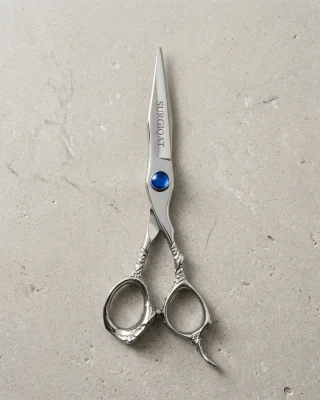
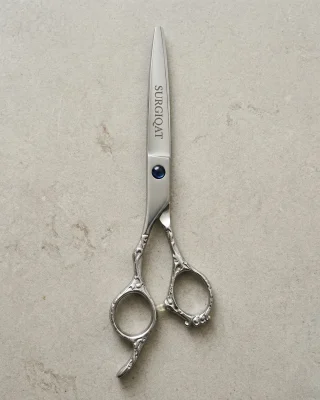
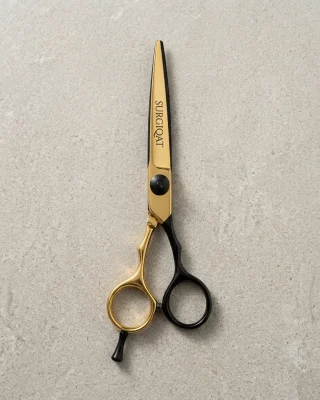
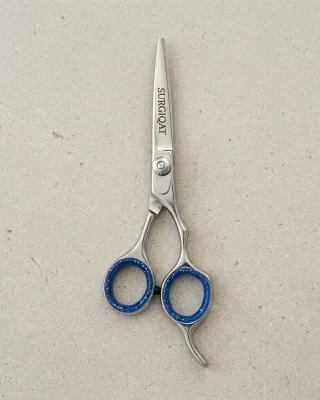
Delivering your private-label convex shears in custom individual pouches, padded protective cases, or fitted branded boxes protects the blades during transit and gives the barber a safe clean home on their station. Surgiqat also offers matte, mirror polish, and 100+ color options—mirror polish highlights the seamless curved clamshell geometry best, while matte and custom color finishes create unmistakable brand identity.