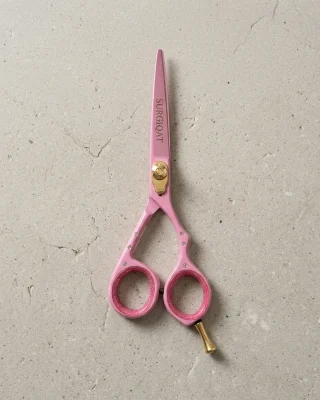
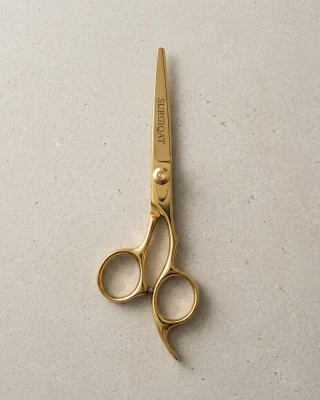
Instant quote in 5 sec
Surgiqat / Catalogue / Offset Handle Scissors

Offset Handle Scissors: 5 Practical Ergonomic Specs for Brands

Even a razor-sharp blade leaves barbers with aching thumbs and stiff wrists when bad handle geometry forces an unnatural pinch all shift. Surgiqat solves hand fatigue with ergonomic offset handle scissors crafted from Japanese steel and balanced for all-day control, starting at 20 pairs per type with one-week samples and 3 to 4 week bulk runs.

MOQ20 units per type
Sample1 week
Production3 to 4 weeks
ShipsYour doorstep

Why Working Barbers Leave Symmetrical Handles Behind

For decades, almost every barber scissor on the market used a classic opposing handle—two identical shanks with finger and thumb rings stacked straight across from each other. That symmetrical shape looks clean in a catalog photo, and traditionally trained barbers who flip their shears frequently still like it.

Put a symmetrical handle in a busy modern barbershop doing 18 to 25 fades a day, though, and the biomechanics catch up fast. To keep the blades level with an opposing handle, the barber has to pull their thumb backward past its natural resting line and hike their elbow up toward shoulder height.

According to U.S. OSHA bent-wrist ergonomics guidance, performing repetitive hand-intensive tasks with a bent wrist forces tendons and tendon sheaths to rub against wrist bones and ligaments—triggering irritation, tendonitis, and nerve compression. OSHA specifically notes that angled or modified tool handles help users keep a straight, neutral wrist.

Similarly, the U.S. National Library of Medicine (MedlinePlus) explains that swollen tendons inside the narrow carpal tunnel squeeze the median nerve controlling thumb movement and feeling, and recommends keeping wrists in a natural posture and using ergonomic tools to cut daily hand strain.

An offset grip solves that mechanical pinch directly. By shortening the thumb shank and shifting the thumb ring forward under the ring finger, an offset handle lets the thumb sit naturally where it wants to rest—cutting thumb travel distance on every single snip and letting the elbow drop lower.

The Five Ergonomic Specs That Separate Real Offset Handle Scissors From Cheap Copies

Here is a problem wholesale distributors run into constantly: a factory takes a basic symmetrical mold, nudges the thumb ring a few millimeters forward, and labels it "ergonomic offset." When barbers buy that pair, their wrist still bends awkwardly, their thumb knuckle still rubs raw, and they leave reviews saying the handle feels no better than a cheap straight shear.

When you source from an offset handle scissors manufacturer, five physical details determine whether the handle genuinely protects the barber's hand or just looks curved in product photos.

1. True Shank Offset vs. Barely-Shifted "Semi-Offset"

A genuine offset handle noticeably shortens the thumb shank relative to the finger shank. When the barber slips their ring finger into the top ring and their thumb into the bottom ring, the thumb tip sits comfortably below the ring finger instead of stretching backward toward the wrist.

Hold the closed shear flat on a table and trace a straight line through the center of the finger ring and pivot. On true offset shears, the thumb ring sits clearly forward and angled slightly downward. If both rings still line up nearly side by side, you are looking at a cosmetic semi-offset that will not satisfy comfort-focused buyers.

2. Inner Ring Beveling and Thumb-Angle Comfort

Read real barber complaints about mid-tier offset shears, and one detail shows up surprisingly often: painful calluses or red pressure spots along the inside of the thumb knuckle. That rarely comes from the handle shape itself—it comes from sharp, unpolished inner ring edges or a thumb ring cast at a rigid 90-degree wall angle.

When a thumb moves in and out of the ring thousands of times a week, flat or sharp ring rims dig straight into the skin. Smoothly rounded, cleanly polished inner ring walls allow the thumb to pivot slightly without chafing—and pairing standard ring sizing with removable rubber finger inserts lets barbers with slender or wider fingers dial in a snug, slip-free fit.

3. Finger-Rest Stability and Shank Balance

Because the thumb shank on an offset shear is shorter than the finger shank, weight distribution shifts subtly toward the blades if the factory does not balance the shanks properly. A poorly balanced 6.5-inch offset shear feels nose-heavy, forcing the ring finger and pinky to fight tip drop all afternoon.

Check the finger tang (finger rest) at the same time. Whether your brand specs a fixed cast tang or a removable screw-in tang, cheap threads wobble loose after two weeks of shop use. A solid, tight-fitting finger rest anchors the pinky cleanly so the barber does not have to death-grip the handles for control.

4. Matching Handle Drop to Real Cutting Styles

Offset handles sit in the sweet spot for most wholesale catalogs, yet they are not the only handle barbers ask for. Understanding how all four Surgiqat handle styles compare helps distributors position offset handle scissors honestly instead of claiming one grip fits every hand:

Handle Style

Thumb & Wrist Posture

Elbow Position

Best Buyer Fit

Honest Trade-Off

Classic (Straight)

Symmetrical rings; thumb pulls slightly back

Higher elbow posture

Traditional barbers who cut with middle finger or flip shears often

Higher wrist and thumb strain during long high-volume shifts

Offset

Shorter thumb shank; thumb rests naturally under ring finger

Moderately lowered elbow

Modern barbers and stylists using standard ring-finger grip (highest volume seller)

Less suited for barbers who constantly flip blades backward

Crane

Steeper downward handle drop; blades stay horizontal

Lowest, most relaxed elbow

Barbers with existing shoulder, neck, or wrist fatigue

Takes a few days of adjustment for barbers used to classic handles

Swivel

Rotating thumb ring tracks natural thumb angle freely

Neutral wrist at steep vertical/angled cuts

Heavy scissor-over-comb specialists and ergonomic-focused stylists

Slightly higher unit cost and short learning curve

For most salon supply stores and private-label brands, offset models should anchor 60% to 70% of core SKUs, with crane and swivel models positioned as ergonomic upgrades and classic handles retained for traditionalists and barber schools.

5. True Left-Handed Offset Geometry (Not Flipped Right-Handers)

Offset handles expose fake left-handed scissors immediately. Because the thumb shank is asymmetrical, a factory cannot simply unscrew a finger rest and flip a right-handed offset shear upside down without putting the angled thumb ring completely backward.

Worse, some low-cost suppliers mount a left-handed handle onto right-handed blades. When a left-handed barber closes those blades, natural thumb pressure pushes the cutting edges apart, causing instant hair folding and forcing painful extra squeeze.

Surgiqat manufactures both right-handed and true left-handed offset handle scissors—combining true reversed blade orientation with proper left-side offset shank geometry so left-handed barbers get effortless closing action and neutral wrist comfort.
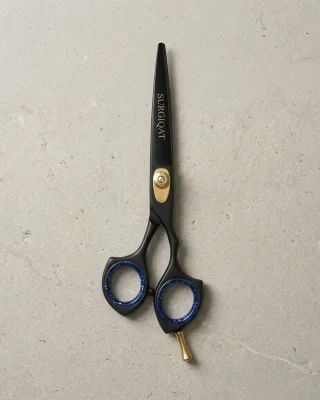
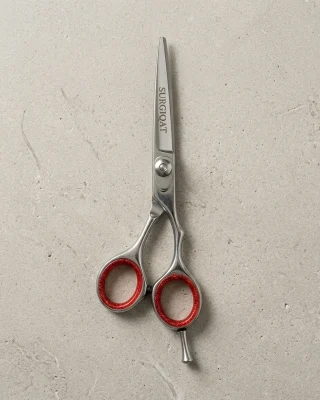
Why an Ergonomic Handle Still Fails When the Blade or Pivot Drags

Even the cleanest offset geometry cannot save a barber's hand if the scissor takes twice as much force to close. Think about how hand fatigue actually builds during a busy day: every time a dull edge pushes hair or a sticky pivot resists movement, the barber squeezes harder with their thumb to compensate.

That extra pinch force wipes out every ergonomic benefit the handle was supposed to deliver. When specifying OEM ergonomic barber scissors, the handle, blade grind, pivot hardware, and steel grade must work together as one balanced system.

Pairing Offset Handles With the Right Blade Grind

Surgiqat lets you match your offset handles to four distinct blade grinds depending on your target buyer:

Convex edge: Ultra-sharp curved outer face that glides silently through wet or dry hair with minimal closing pressure—ideal for pairing with offset handles on flagship ergonomic lines.

Semi-convex edge: Balanced daily workhorse combining smooth slicing with extra edge strength for high-volume barbershops cutting coarse dry hair.

Beveled edge: Durable, straightforward grind well suited for barber academies, entry-level offset starter kits, and blunt scissor-over-comb work.

Micro-serrated edge: Tiny gripping teeth along one edge hold slippery straight hair steady during clean perimeter work (not meant for slide cutting).

Choosing Low-Friction Tension Hardware

A sticky pivot screw turns an ergonomic shear into a thumb workout. Specifying the right tension system keeps closing action light and predictable across hundreds of cuts:

Ball-bearing pivot: Minimizes internal metal-on-metal friction so blades glide open and closed with feather-light thumb pressure—the top pairing for premium ergonomic offset shears.

Dial / click tension adjuster: Allows quick fingertip micro-adjustments between clients while the notched click resists loosening mid-shift.

Flat screw: Low-profile flush hardware that slides smoothly along flat barber combs without snagging teeth.

Japanese Steel Tiers and Real Verification Papers for Wholesale Offset Barber Shears

Handle comfort gets a barber to pick up a shear in a showroom; steel retention decides whether they buy from your brand again six months later. Because offset handle scissors are built for long, high-volume shifts, matching the steel tier to the buyer's actual daily workload prevents early dulling complaints.

Surgiqat manufactures wholesale offset barber shears using Japanese steel across three clear standard tiers, plus two specialty grades strictly for custom projects:

Japanese Steel Grade

Tier

Best Catalog Role

Practical Buying Note

J1

Basic

Barber colleges, student ergonomic kits, budget retail

Introduces students to proper offset grip early at an accessible unit cost

J2

Normal

Everyday salon supply and mid-tier barbershop lines

Reliable balance of edge life and wholesale margin for volume catalogs

440C

Professional

Busy daily barbershops and flagship private-label lines

Stronger edge retention for barbers cutting back-to-back shifts all week

VG10

Custom only

Custom-spec flagship briefs

Quoted strictly when a buyer brings a genuine custom brief—never pushed as a usual first order

ATS-314

Custom only

Custom-spec specialty briefs

Available strictly for custom projects—not positioned as a standard first-order steel

Factual Steel Reports Instead of Unverified Certificates

Experienced distributors know better than to trust vague certificate logos printed on scissor boxes. Surgiqat does not claim company ISO, CE, or FDA certificates. Instead, when wholesale buyers want verifiable proof behind their steel batch, three straightforward steel test reports are available on request:

Material Test Report (MTR) / Material Test Certificate (MTC): Documents the steel batch specification and traceability.

Chemical Composition Analysis: Confirms the actual alloy chemistry matches the grade on your purchase order.

Hardness Test Report: Verifies tested batch hardness on paper rather than relying on verbal promises.

Finishes, Color-Coding, and Daily Station Care

Ergonomic shears spend eight to ten hours a day in warm hands coated with hair product, water, and salon disinfectant. Surface finish affects both grip feel and how cleanly the handles wipe down between clients.

Surgiqat offers matte, mirror polish, and 100+ color options across your offset shear catalog:

Mirror polish sheds water, hair clippings, and product residue effortlessly and wipes clean in seconds after disinfection.

Matte finishes eliminate harsh overhead glare and resist fingerprints along the offset shanks.

100+ color options let private-label brands build signature collections—or color-code ergonomic tiers (for example, matte black for 440C ball-bearing offsets and brushed silver for J2 dial-tension offsets) so salon reps and retail shoppers spot the upgrade instantly.

Remind end-users on a short care insert inside your box: wipe the blades and pivot completely dry after sanitizing, add one drop of shear oil at the screw at the end of each shift, and avoid leaving offset handles soaking wet in disinfectant trays overnight.

Building a High-Converting Line With an Offset Handle Scissors Manufacturer

Many private-label brands stall out because they think launching ergonomic shears means ordering hundreds of pieces per SKU before testing demand. Surgiqat keeps your launch lean, verifiable, and repeatable from day one.

Step 1: Check Ballpark Margins in 5 Seconds

Before drafting a long specification email, we recommend running your target quantities, steel tier, and finish choices through our 5-Second Wholesale Grooming Tools Estimate Calculator. You get an instant downloadable PDF estimate to share with your purchasing team or business partner—then send it to us so we can confirm final OEM pricing within 24 hours.

Step 2: Test the Grip in Real Hands (One-Week Paid Sample)

Handle ergonomics cannot be judged from a spec sheet alone. Order samples ready in one week and have two working barbers cut with them for a full afternoon. Have them check four exact feel points:

Does the thumb sit naturally below the ring finger without stretching back?

Are the inside ring rims completely smooth with zero sharp casting lines?

Does the shear balance level across one finger at the pivot screw instead of dipping tip-first?

Does the blade open and close smoothly with light thumb pressure and zero tip gap on a damp tissue?

Once you sign off, Surgiqat keeps your approved sample on file as the golden reference standard so your bulk batch matches the exact feel, tension, and balance you approved.

Step 3: Lock In Private-Label Branding and Packaging

Send your logo file for laser logo engraving. We send a digital logo placement proof before marking a single shear so you verify crisp alignment on the blade or shank first. Pair your models with custom packaging—individual pouches, protective cases, or branded boxes. All client logos and exclusive custom designs remain strictly confidential and are never resold to competing buyers.

Step 4: Bulk Production, Piece-by-Piece QC, and Consistent Reorders

Bulk orders start at 20 scissors per type, making it easy to stock right-handed and true left-handed offset models—or pair cutting and thinning offsets together—without tying up capital. Production takes 3 to 4 weeks.

Before packing, every individual scissor is checked for blade alignment, screw tension, and smooth cutting action. Before dispatch, we send pre-shipment photos and a cutting-test video of your finished batch. We also archive your complete buyer spec sheet so future reorders come out identical to your first batch, and back every order with our 15-day manufacturing-defect warranty.

Ready to price your ergonomic line or book your one-week sample? Build your instant PDF estimate online or reach our factory team directly at [email protected] or WhatsApp +92 309 6013766—all inquiries are answered within 24 hours.

Frequently Asked Questions About Offset Handle Scissors

Why do most professional barbers prefer offset handle scissors over classic straight handles?

Offset handle scissors feature a shorter thumb shank that lets the thumb rest naturally beneath the ring finger instead of stretching backward. This keeps the wrist straighter, lowers the elbow, and reduces repetitive thumb and hand fatigue during full barbershop shifts.

What is the minimum order quantity for wholesale offset barber shears?

The minimum order is 20 scissors per type. That low entry volume lets distributors, salon supply stores, and private-label brands test multiple finishes, blade grinds, or true left-handed models without heavy inventory risk.

Can I get a ballpark quote before ordering a physical sample?

Yes. We recommend using our 5-Second Wholesale Grooming Tools Estimate Calculator to generate an instant downloadable PDF ballpark estimate. Physical samples are ready in one week, and final OEM quotes are confirmed within 24 hours via [email protected] or WhatsApp +92 309 6013766.

How long does bulk production take for OEM ergonomic barber scissors?

Bulk production takes 3 to 4 weeks. Your approved sample serves as the bulk production reference, every piece is hand-checked for alignment, tension, and cutting action, and we send pre-shipment photos and a cutting-test video before dispatch.

Do you manufacture true left-handed offset shears?

Yes. We produce both right-handed and true left-handed offset handle scissors with reversed blade orientation and proper left-side offset shank geometry—never flipped right-handed assemblies.

Which Japanese steel grades and steel test reports are available?

Standard orders use Japanese J1 (Basic), J2 (Normal), or 440C (Professional), with VG10 and ATS-314 available strictly for custom briefs. While we do not claim company ISO, CE, or FDA certificates, we can arrange three standard steel reports on request: Material Test Report / Certificate (MTR/MTC), Chemical Composition Analysis, and Hardness Test Report.

What branding, packaging, and warranty options come with private-label orders?

We offer laser logo engraving (with a digital placement proof beforehand), matte, mirror polish, and 100+ color options, custom pouches, cases, or branded boxes, full confidentiality on client logos and custom designs, archived spec sheets for repeat orders, and a 15-day manufacturing-defect warranty.

Talk to the manufacturer.