Instant quote in 5 sec
Surgiqat / Catalogue / Barber Texturizing Scissors

Barber Texturizing Scissors: 4 Essential OEM Details to Know

Wide-tooth barber texturizing scissors capture heavier hair bundles per cut, so minor flaws in tooth clearance or pivot alignment quickly cause blade lock, tugging, and customer returns. Surgiqat manufactures wholesale texturizing shears in Japanese steel with precision-aligned teeth and verified tension, starting at 20 pairs per type with one-week samples and 3 to 4 week bulk runs.

MOQ20 units per type
Sample1 week
Production3 to 4 weeks
ShipsYour doorstep

Texturizing vs. Thinning: Why Wide-Gap Teeth Behave Completely Differently

Many salon supply catalogs lump thinning, blending, and texturizing scissors into one vague listing. Working barbers know better—and they spot the mismatch on the first snip.

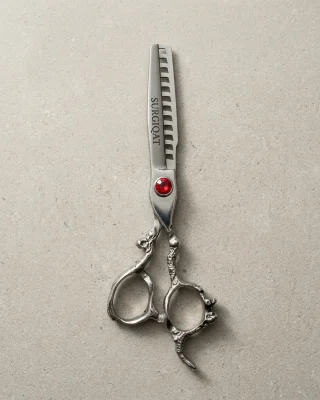
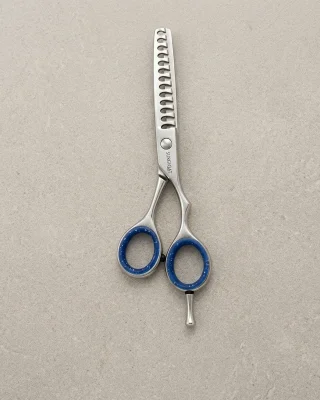
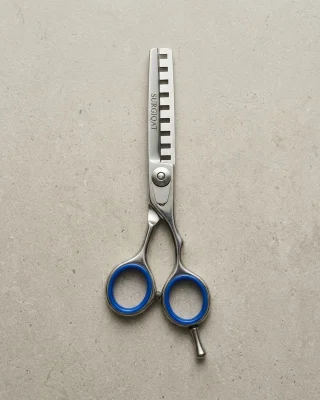
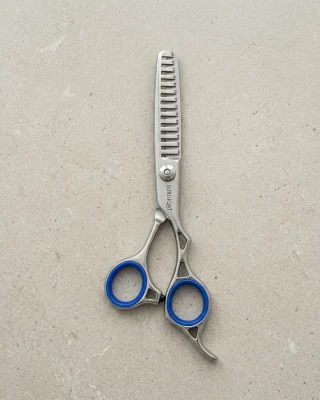
A standard thinning scissor packs 28 to 40+ narrow teeth closely together so every close trims tiny, scattered strands invisibly. Barber texturizing scissors do the opposite. They use fewer, wider teeth with broader open gaps—often anywhere from 7 to 22 teeth—so each close carves out a deliberate chunk of weight and leaves visible separation between neighboring sections.

That mechanical difference changes how the hair behaves during the cut. Instead of gently dusting away weight around a fade, wide-gap teeth bite through dense dry hair bundles to build choppy movement, lift flat crowns, and break up heavy perimeter lines.

When a brand sells a 14-tooth texturizer under a generic "thinning shear" label, barbers use it near the top of fine hair or across tight curls—and end up creating wispy gaps or frizzy halos. Naming your SKUs accurately and explaining exact tooth count on your product cards protects both your buyers and your brand reputation.

The Mechanical Defect That Ruins Wholesale Texturizing Shears: Blade-to-Tooth Lock

Read real barber reviews of low-cost texturizing shears online, and one specific mechanical complaint stands out far more than on straight shears: "The cutting blade hits the teeth and gets stuck."

Why does blade-to-tooth lock happen so often on wide-gap texturizers? Look at the physics inside the cut. When a wide gap traps a thick bundle of coarse dry hair, that hair pushes sideways against the solid blade right before it severs. If the blades lack proper curve (blade set) or the pivot screw has side-to-side play, the solid blade deflects slightly into the edge of the next tooth—causing a metallic click, a hard stop, or a chipped corner.

Four Engineering Checkpoints a Barber Texturizing Scissors Manufacturer Must Control

Uniform blade curve (set): Both blades need a calibrated inward arc from pivot to tip so the solid edge glides smoothly over the face of each tooth without dipping into the wide open gaps.

Deburred tooth corners and roots: Wide slots collect thicker hair clusters. Any sharp burr at the tooth corner or bottom of the slot grabs hair when the barber pulls the scissor out of a dry section.

Rigid pivot assembly: Wide-tooth cutting creates higher lateral torque at the screw than fine blending. Cheap, loose flat screws wobble under load and let the blades collide.

Individual cutting-action verification: Machine assembly alone never catches a single high tooth. Every pair has to be opened, closed, and test-cut by hand before packing.

Specifying the Right Hair-Type and Tooth-Gap Matrix for Your Catalog

Distributors build stronger repeat business when their catalog helps barbers pick the right texturizing bite instead of guessing. Two distinct wide-tooth tiers cover almost all barbershop demand:

Texturizer Style

Typical Tooth Range

Hair-Removal Character

Best Hair Types & Cuts

Where Barbers Should Hold Back

Aggressive / Chunky Texturizer

~7 to 14 wide teeth

Bold separation, rapid internal bulk removal

Very thick, coarse, straight, or heavy wavy hair; messy crops and textured tops

Avoid on fine, low-density hair or tight curl clumps—removes too much weight in one pass

Versatile Daily Texturizer

~15 to 22 medium-wide teeth

Controlled movement, softer piecey ends

Medium-to-thick hair, layered men's cuts, softening heavy clipper-to-scissor transitions

Use sparingly near the crown or hairline to prevent short flyaways

What to Put on Your Product Page and Box Insert

If you sell private-label wholesale texturizing shears, include three quick lines on the packaging or insert card: the exact tooth count, whether the shear is designed for aggressive chunking or medium texture, and a quick reminder never to snip paper, foil, or packaging ties with the blades (cutting non-hair materials instantly rolls the tooth corners and ruins alignment). Educated buyers blame their technique far less often—and trust your brand far more.

Steel Toughness, Solid-Blade Grinds, and Real Lab Verification

Because wide teeth take heavier bites on dry hair, the opposite solid blade absorbs far more impact per close than a fine blender. If that solid blade is too soft, the edge flattens quickly, hair bends sideways into the tooth gap instead of slicing cleanly, and the barber has to squeeze twice as hard.

Matching Solid-Blade Grinds to Wide-Tooth Cutting

At Surgiqat, you can pair your toothed blade with four proven solid-blade grinds depending on your target market:

Semi-Convex: Often the smartest all-around choice for daily barber texturizing scissors—sharp enough to slice dry bundles cleanly while keeping enough steel support behind the edge to resist chipping against thick coarse hair.

Convex: Ultra-smooth slicing for experienced stylists doing dry point-texturizing and slide-out movement work, where minimal resistance matters most.

Beveled: Tough, forgiving edge ideal for student kits, high-volume academy packs, and entry-level wholesale lines.

Micro-Serrated: Holds slippery straight hair steady during blunt texturizing cuts (not intended for slide-out motions).

Japanese Steel Tiers and Straightforward Steel Reports

Surgiqat manufactures barber texturizing scissors using Japanese steel across three practical standard tiers, plus two specialty grades strictly for custom projects:

J1 (Basic): Built for barber school kits and entry-level retail packs where price sensitivity leads the buying decision.

J2 (Normal): Reliable everyday mid-tier steel suited for general barbershop and salon distribution catalogs.

440C (Professional): Our workhorse professional steel for busy barbershops and flagship private-label lines needing stronger edge longevity under heavy dry cutting.

VG10 and ATS-314 (Custom only): Quoted exclusively when a buyer brings a true custom brief—not positioned as a standard first-order steel.

Rather than hiding behind unverified certificate badges—Surgiqat does not claim company ISO, CE, or FDA certificates—we give distributors factual steel paperwork when requested:

Material Test Report (MTR) / Material Test Certificate (MTC) documenting the batch material specification.

Chemical Composition Analysis confirming the actual alloy chemistry.

Hardness Test Report verifying the tested batch hardness on paper.

Wrist Comfort, Left-Handed Builds, and Keeping Wide Tooth Slots Clean

Texturizing requires quick, repetitive vertical and diagonal wrist angles—often held high around the crown or angled into thick dry layers. The U.S. Office of Personnel Management Job Grading Standard for Barbering specifically notes that daily barbering demands continuous fine finger and thumb dexterity, exposes barbers to physical strains, and requires sanitizing barbering tools after each client.

Choosing Handles and Pivots That Absorb Heavy Bite Load

When a shear bites through thick dry hair, hand comfort depends on both handle geometry and pivot hardware:

Handle styles: Choose from classic (straight), offset, crane, and swivel handles. For texturizing, offset, crane, and swivel designs are especially popular because they keep the wrist neutral when barbers rotate the shear vertically to carve texture into the top of a cut.

True left-handed models: Never sell flipped right-handed texturizers to left-handed barbers—if the toothed blade sits on the wrong side, left-thumb pressure pushes the blades apart and causes instant snagging. Surgiqat builds true left-handed texturizing scissors with properly reversed blade orientation.

Pivot tension systems: Pair wide-tooth blades with a flat screw (sleek profile), a dial/click tension adjuster (fast mid-shift control that resists loosening), or a ball-bearing pivot (lowest friction and tightest side-load stability during heavy dry cutting).

Hygiene, Storage, and Durable Finishes

Wide tooth gaps and pivot joints naturally collect cut hair, styling wax, and moisture during busy shifts. Research published via NIH / PubMed Central emphasizes that salon tools must be properly sanitized and stored in cool, dry, closed containers because trapped moisture and dust accelerate microbial buildup and degrade tool surfaces.

Surgiqat finishes OEM texturizing scissors in matte, mirror polish, and 100+ color options. Smooth mirror polish wipes styling product off wide tooth slots effortlessly, matte eliminates harsh station glare, and 100+ color options let brands visually distinguish aggressive chunkers from medium texturizers at a glance on a crowded barber mat.

Planning an OEM Texturizing Scissors Order (From 5-Second Estimate to Bulk Dispatch)

Launching or expanding a texturizing line does not require guesswork or massive upfront inventory. Here is the four-step workflow most distributors follow with Surgiqat:

Step 1: Build Your Instant 5-Second Ballpark PDF Estimate

Before writing a long email or waiting for a manual price sheet, we recommend running your target specs through our 5-Second Wholesale Grooming Tools Estimate Calculator. Select your product type, steel tier, finish, and quantity to download a clean PDF estimate in seconds—easy to review with your business partner or purchasing team before requesting final OEM confirmation.

Step 2: Test a One-Week Sample on Real Hair

Samples are ready in one week. When your sample arrives, do not just open and close it in the air:

Close slowly with slight thumb pressure to verify zero tooth clicking or catching.

Take three dry bites on thick hair and pull straight out to confirm clean release with zero snagging.

Check pivot tension stability after ten rapid snips.

Once you approve the sample, Surgiqat keeps an approved reference copy on file so your bulk order matches that exact tension, clearance, and edge finish.

Step 3: Lock In Branding, Packaging, and Confidentiality

Send your logo file for laser logo engraving. We send a digital logo placement proof before marking a single blade so you verify alignment and sizing upfront. Choose custom packaging—individual pouches, protective cases, or branded boxes—knowing your client logo and any exclusive custom designs remain strictly confidential and are never resold.

Step 4: Bulk Production, Pre-Shipment Proof, and Repeatable Reorders

Bulk orders start at 20 scissors per type and complete production in 3 to 4 weeks. Every individual scissor is hand-checked for blade alignment, screw tension, and smooth cutting action before packing. Before dispatch, we send pre-shipment photos and a cutting-test video of your finished batch.

We archive your complete buyer spec sheet so future reorders come out identical to your first approved run, and every order is backed by our 15-day manufacturing-defect warranty.

Ready to confirm pricing or request your one-week sample? Download your instant PDF estimate or contact our factory team directly at [email protected] or WhatsApp +92 309 6013766—all inquiries are answered within 24 hours.

Frequently Asked Questions About Barber Texturizing Scissors

How are barber texturizing scissors different from standard thinning scissors?

Texturizing scissors have fewer, wider-spaced teeth (commonly 7 to 22 teeth) that remove noticeable chunks of weight to create visible separation and movement. Standard thinning scissors use 28 to 40+ narrower teeth to soften weight lines invisibly.

Why do cheap wholesale texturizing shears catch or lock on the teeth?

Blade-to-tooth lock happens when uneven blade curve, sloppy pivot play, or rough tooth corners let the solid blade deflect into a wide tooth gap under heavy dry cutting load. Individual alignment, tension, and cutting checks before packing prevent defective pairs from shipping.

What is the minimum order quantity for OEM texturizing scissors?

The minimum order is 20 scissors per type, making it practical to stock both aggressive wide-tooth models and medium daily texturizers—or add true left-handed versions—without heavy upfront stock.

How fast can I get a ballpark price and a physical sample?

You can generate a downloadable ballpark PDF in seconds using our 5-Second Wholesale Grooming Tools Estimate Calculator. Physical samples are ready in one week, and bulk production takes 3 to 4 weeks.

Which Japanese steel should I choose for heavy dry texturizing?

440C (Professional) is the strongest standard pick for busy barbershops cutting thick dry hair daily. J2 (Normal) fits mid-tier salon catalogs, and J1 (Basic) works for school or budget kits. VG10 and ATS-314 are quoted strictly for custom briefs.

What steel documentation can Surgiqat provide with my bulk order?

We do not claim company ISO, CE, or FDA certificates. On request, we can provide three standard steel reports: a Material Test Report / Certificate (MTR/MTC), a Chemical Composition Analysis, and a Hardness Test Report.

What happens if a manufacturing defect shows up in my bulk batch?

Every batch is inspected piece by piece and verified with pre-shipment photos and a cutting-test video before dispatch, and orders are protected by a 15-day manufacturing-defect warranty.

Talk to the manufacturer.