Instant quote in 5 sec
Surgiqat / Catalogue / Barber Thinning Scissors

Barber Thinning Scissors: 5 Proven Specs Every Buyer Needs

Barbers toss poor barber thinning scissors into a drawer for one reason: they pull hair on the way out and leave harsh chop lines. Surgiqat eliminates snagging with hand-finished Japanese steel teeth calibrated for smooth strand release, starting at 20 pairs per type with one-week samples and 3 to 4 week bulk production.

MOQ20 units per type
Sample1 week
Production3 to 4 weeks
ShipsYour doorstep

What Actually Separates Good Barber Thinning Scissors From Cheap Hair-Pullers

A thinning shear is a harder tool to manufacture cleanly than a standard straight cutting scissor. Instead of two smooth edges sweeping past each other, one solid blade has to track smoothly across twenty, thirty, or forty individual metal teeth without catching a single corner.

When a low-grade factory rushes tooth milling, two problems show up immediately in the chair. First, microscopic burrs remain inside the bottom of each tooth slot. Hair gets trapped in those rough valleys, so when the barber pulls the scissor out of the section, uncut strands tug painfully at the client's scalp.

Second, the tips of the teeth sit slightly misaligned with the curve of the solid blade. You can actually hear this defect before you even cut hair: close the blades slowly near your ear and listen for a metallic click or snag halfway down the stroke. Once a tooth clips the straight edge, both blades start dulling fast.

That is why buyers sourcing from a barber thinning scissors manufacturer should never judge a sample on looks alone. Smooth tooth valleys, clean tip geometry, and a calibrated ride line on the solid blade do all the real work.

Tooth Count, Notch Shape, and Cut Ratio: Stop Selling the Wrong Tool for the Job

One of the fastest ways a private-label brand earns bad reviews is mislabeling tooth counts. A barber buys a pair expecting soft fade blending, opens the box, and gets a wide-tooth shear that leaves harsh steps and frizzy short flyaways near the crown.

Every thinning scissor removes a specific percentage of hair per close—called the cut ratio. That ratio comes from two physical measurements: how many teeth sit along the blade, and how wide the gaps are between them.

Tooth Configuration

Approximate Hair Removal

Ideal Chair Application

Common Wholesale Mistake

Fine Blending (35–42+ teeth)

Light (~15%–25%)

Seamless fade transitions, softening weight lines, fine-to-medium hair

Under-ordered by new brands even though barbers use fine thinners daily

All-Around Standard (28–32 teeth)

Moderate (~25%–35%)

Daily weight removal, blending crown into sides, most salon catalogs

Sold as a one-size-fits-all tool without clarifying cut ratio on packaging

Heavy Bulk / Texturizing (14–22 teeth)

Heavy (~35%–50%+)

Thick, dense hair, rapid bulk removal, choppy modern texture

Marketed simply as "thinning shears," shocking buyers who wanted soft blending

Why Tooth Tip Shape Matters Just as Much as Tooth Count

Look at the very tip of each tooth under magnification. On standard barber thinning scissors, manufacturers typically cut either a tiny V-notch (a small serrated groove at the top of each tooth) or a smooth flat/curved tip.

Micro-notched (V-notch) teeth hold hair strands slightly in place as the solid blade passes, giving predictable, even cuts on straight or slippery wet hair. The downside: if the V-notch is machined roughly, it grabs hair during exit.

Smooth / non-notched teeth release hair with almost zero drag, making them popular for dry blending and fast exit strokes—provided the solid cutting blade stays razor sharp.

When you plan a wholesale thinning shears catalog, clearly listing tooth count and intended cut feel on your product page and packaging prevents 80% of "this cut too much hair" customer complaints.

The Hidden Half of the Shear: Why the Solid Blade Decides Lifespan

Buyers spend plenty of time counting teeth and almost zero time asking about the opposite solid blade. In reality, the solid blade does almost all the actual slicing while the toothed blade acts as a comb and anvil.

If the solid blade is ground too blunt—or stamped from soft steel that rolls after a few busy weekends—the hair does not shear cleanly against the teeth. Instead, the hair folds between the tooth edge and the solid edge. The barber feels drag, squeezes harder, and blames the teeth for pulling.

Edge Grinds Available on the Solid Blade

At Surgiqat, you can match the solid blade grind on your OEM thinning scissors to the price tier and cutting style of your market:

Convex edge: Silky, ultra-sharp slice ideal for professional dry and wet blending with minimal push.

Semi-convex edge: Strong middle ground combining smooth slicing with better edge durability for busy high-volume barbershops.

Beveled edge: Durable, straightforward grind well suited for barber academies, starter kits, and high-turnover budget catalogs.

Micro-serrated edge: Grips hair firmly on straight blunt passes (used less often on fine thinners, mostly reserved for specialized grip specs).

Japanese Steel Tiers and Real Verification Papers

Because thinning shears get used repeatedly on dry, coarse hair around the crown and sides, steel choice directly impacts how often a barber has to send them to a sharpener. Surgiqat manufactures with Japanese steel across three clear standard tiers, plus two custom-only grades:

J1 (Basic): Built for barber school kits and price-sensitive starter lines where accessible unit cost matters most.

J2 (Normal): Solid everyday tier for general salon supply catalogs and balanced retail pricing.

440C (Professional): Our primary workhorse steel for professional barbershop brands demanding longer edge retention between sharpenings.

VG10 and ATS-314 (Custom only): Quoted strictly when a buyer brings a genuine custom brief—never pushed as a standard first-order steel.

Instead of printing meaningless certificate badges on your box, Surgiqat stays transparent: we do not claim company ISO, CE, or FDA certificates. When wholesale buyers want real verification on their steel batch, we provide three practical steel test reports on request:

Material Test Report (MTR) / Material Test Certificate (MTC) for steel batch traceability.

Chemical Composition Analysis to confirm the alloy matches the ordered grade.

Hardness Test Report documenting the tested batch hardness without relying on unverified claims.

Ergonomics, True Left-Handed Thinners, and Tension Control

Thinning often happens in awkward positions—elevated elbows around the crown, vertical blending behind the ear, and dozens of rapid partial snips across thick sections. According to the California Board of Barbering and Cosmetology ergonomics guide, holding shears with a bent wrist across different hair sections contributes directly to hand, wrist, shoulder, and neck strain, which well-fitted equipment and proper handle design help reduce.

Matching Handles and Tension Screws to Thinning Mechanics

Unlike straight shears where barbers often take long single strokes, thinning shears get opened and closed rapidly in short bursts. That makes smooth pivot action and comfortable thumb placement critical.

Handle styles: Surgiqat produces classic (straight), offset, crane, and swivel handles. For most modern wholesale thinning shears, an offset or crane handle outsells classic straight handles because it lets the thumb relax lower during crown blending.

Tension systems: Choose from flat screws (sleek, comb-friendly profile), dial/click adjusters (quick fingertip tension tweaks that resist loosening mid-shift), or ball-bearing pivots (lowest closing friction for all-day comfort).

The Left-Handed Thinning Mistake Most Catalogs Make

Left-handed barbers are one of the most frustrated buyer groups in the industry—and thinning shears are where cheap brands cut corners most often. If a supplier takes a right-handed thinner and simply flips the finger rest, the toothed blade stays on the wrong side for a left hand. Every time the barber closes their thumb, natural lateral pressure pushes the solid blade away from the teeth instead of against them.

The result is instant hair folding, pulling, and hand cramping. Surgiqat builds true left-handed barber thinning scissors with reversed blade orientation so the cutting blade and toothed blade pull tightly together under natural left-thumb pressure. Offering true left-handed versions alongside your right-handed core SKUs gives your brand a genuine competitive edge.

Disinfection, Hair Buildup Between Teeth, and Finish Durability

Thinning scissors trap more debris than any other shear on a barber's station. Tiny clipped hairs pack into the base of the teeth and work their way toward the pivot washer. Add daily salon sanitation chemicals, and neglected blades quickly stiffen or spot.

State health rules make thorough disinfection non-negotiable. For example, Connecticut Department of Public Health salon infection control guidelines require salon tools and implements to be fully submerged in freshly prepared, labeled disinfectant for the full contact time, then rinsed and dried properly.

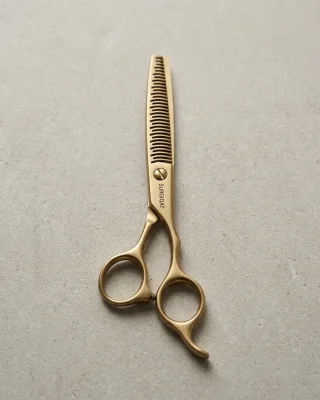
When moisture and disinfectant sit inside notched teeth or under a tension dial, cheap finishes peel and pivots seize. Specifying clean surface finishing—Surgiqat offers matte, mirror polish, and 100+ color options—helps blades wipe clean easily between clients.

Mirror polish sheds tiny hair clippings fastest and makes debris inside tooth valleys easy to spot and brush out.

Matte finishes eliminate glare under bright mirror lighting and disguise daily handling marks.

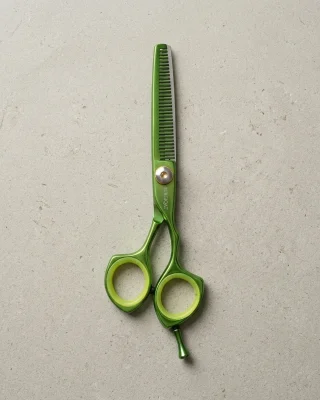
100+ color options let you color-code your thinning line by tooth count (for example, one accent color for fine 40-tooth blenders and another for heavy bulk thinners) or match your cutting shears in coordinated sets.

Remind your end-users on a simple box insert: brush hair out of the teeth after each client, wipe completely dry after disinfection, and add one drop of shear oil at the pivot before closing up for the night.

How to Order OEM Thinning Scissors Without Batch Surprises

Thinning shears show manufacturing shortcuts faster than straight blades—if a single batch has sloppy tooth deburring, every buyer notices on the very first haircut. That is why a disciplined sample-to-bulk process matters so much when working with a barber thinning scissors manufacturer.

What You Get on Every Surgiqat OEM Order

Low entry MOQ: 20 scissors per type, allowing you to test multiple tooth counts, finishes, or true left-handed models without heavy inventory risk.

Fast sample verification: Samples in one week. Once you approve the sample, we keep an approved reference copy on file so bulk production matches your exact edge, tooth smoothness, and tension.

Clear bulk lead time: Production in 3 to 4 weeks for private-label and wholesale runs.

Branding & confidentiality: Laser logo engraving with a digital logo placement proof sent before marking, plus custom packaging options (individual pouches, protective cases, or branded boxes). Client logos and exclusive custom designs remain strictly confidential and are never resold.

Piece-by-piece QC & visual proof: Every single scissor is checked for blade alignment, screw tension, and smooth cutting action before packing. We send pre-shipment photos and a cutting-test video before dispatch.

Consistent reorders & defect protection: We archive your exact spec sheet on file so repeat orders match the original batch, and back orders with a 15-day manufacturing-defect warranty.

Four-Step Sample Test Specifically for Thinning Scissors

When your one-week sample arrives, run these four checks before approving bulk production:

Dry slow-close acoustic test: Open the blades wide and close them slowly without hair. You should feel smooth, even gliding resistance from pivot to tip with zero clicking, catching, or metal-on-metal ticking across the teeth.

Single-pass exit test on real hair: Close the blades once on a dry hair section, open slightly, and pull straight out. If you feel tugging or hear strands snapping on exit, inspect the tooth valleys for burrs.

Tip-tooth alignment check: Look at the last three teeth near the tip under bright light. The solid blade should cross cleanly past the final tooth without leaving an uncut gap.

Tension drop and logo check: Verify the blades hold controlled tension without slamming shut, and confirm your laser logo placement matches the digital proof.

Ready to Spec Your Thinning Line?

Send your target steel (Japanese J1, J2, or 440C—or flag if it is a custom VG10 / ATS-314 project), tooth count, solid-blade grind, handle style, tension system, finish, packaging preference, and logo file directly to [email protected] or WhatsApp +92 309 6013766. Our team replies to all quotes and technical questions within 24 hours.

Want fast ballpark pricing before locking in your sample? We recommend running your numbers through our 5-Second Wholesale Grooming Tools Estimate Tool first. You can download a clean PDF estimate in seconds to share with your purchasing team or business partner, then reply to us for final OEM confirmation within 24 hours.
Frequently Asked Questions About Barber Thinning Scissors

What is the minimum order quantity for wholesale thinning shears?

The minimum order is 20 scissors per type. This allows wholesale distributors, salon supply stores, and private-label brands to introduce multiple tooth counts or finishes without tying up large budgets.

How fast can I get a sample before ordering bulk OEM thinning scissors?

Samples are ready in one week. After you test and approve the sample, we retain an approved reference sample so bulk production matches the same blade action, tooth finish, and tension.

How long does bulk manufacturing take?

Bulk production takes 3 to 4 weeks. Every pair goes through individual alignment, tension, and cutting checks, and we share pre-shipment photos and a cutting-test video before dispatch.

Why do cheap barber thinning scissors pull hair, and how does Surgiqat prevent it?

Pulling usually comes from unpolished burrs inside the tooth notches, a dull solid blade that folds hair instead of cutting it, or loose pivot tension. Checking every pair individually for alignment, tension, and clean cutting action before packing catches those defects before shipment.

Which Japanese steel grade works best for wholesale thinning shears?

Use J1 for basic academy and budget kits, J2 for normal everyday salon lines, and 440C for professional barbershop brands that need stronger edge retention. VG10 and ATS-314 are available strictly for custom briefs rather than typical first orders.

Can you supply steel test reports for my thinning scissors order?

Yes. We do not claim company ISO, CE, or FDA certificates, but we can arrange three standard steel reports on request: a Material Test Report / Certificate (MTR/MTC), a Chemical Composition Analysis, and a Hardness Test Report.

Can I order custom colors, laser logos, and branded boxes?

Yes. We offer matte, mirror polish, and 100+ color options, laser logo engraving (with a digital placement proof sent beforehand), and custom packaging including individual pouches, cases, or branded boxes. Your logo and custom designs are kept confidential.

Do you make true left-handed barber thinning scissors?

Yes. We manufacture both right-handed and true left-handed thinning scissors with reversed blade orientation, backed by our 15-day manufacturing-defect warranty and archived spec sheets for consistent repeat orders.

Talk to the manufacturer.